L I V I N G R O O M
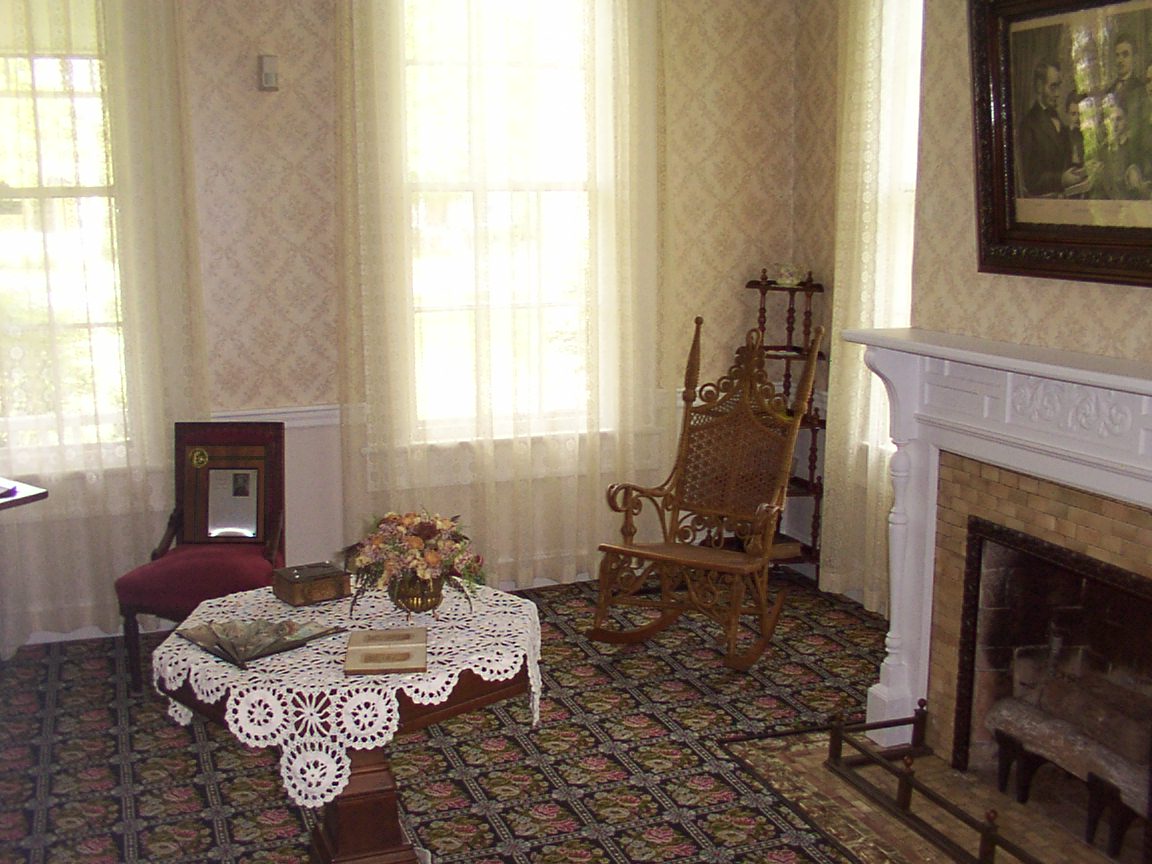 (Also known as the front parlor.)
This shows the way a typical living room of the 1850's would
appear. It has the usual sofa and rocking chairs
and the library table. The secretary, which
those of you who attended Danville High might be interested
in knowing, was made by the grandfather of Katherine
Stapp. It was donated to the Museum by her.
(Also known as the front parlor.)
This shows the way a typical living room of the 1850's would
appear. It has the usual sofa and rocking chairs
and the library table. The secretary, which
those of you who attended Danville High might be interested
in knowing, was made by the grandfather of Katherine
Stapp. It was donated to the Museum by her.
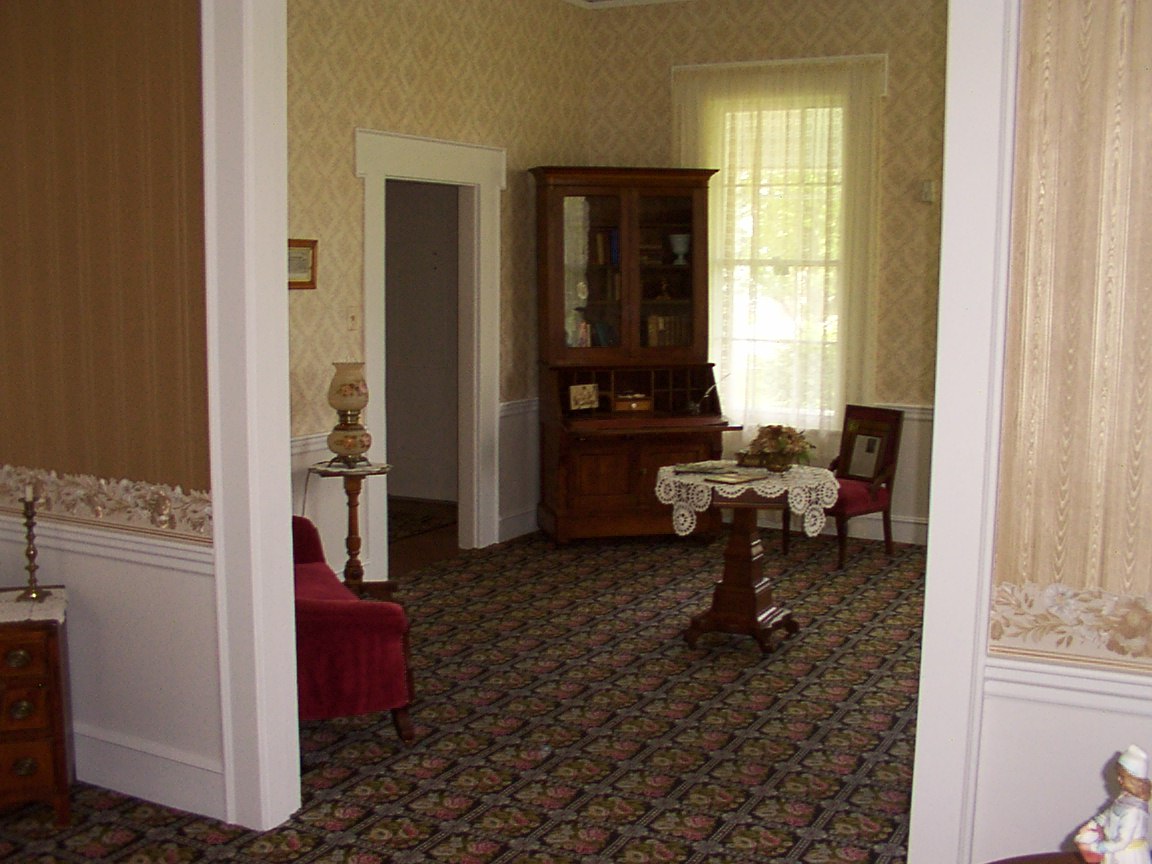 The center table has an 1865 Godey's Lady's Book, as
well as a photograph album. The other
particularly interesting things in the room are the
composite picture of the Lincoln family that hangs over
the fireplace, and a reproduction of the advertisement
concerning the Lincoln-Lamon law partnership that appeared
in contemporary papers.
The center table has an 1865 Godey's Lady's Book, as
well as a photograph album. The other
particularly interesting things in the room are the
composite picture of the Lincoln family that hangs over
the fireplace, and a reproduction of the advertisement
concerning the Lincoln-Lamon law partnership that appeared
in contemporary papers.
D I N I N G R O O M 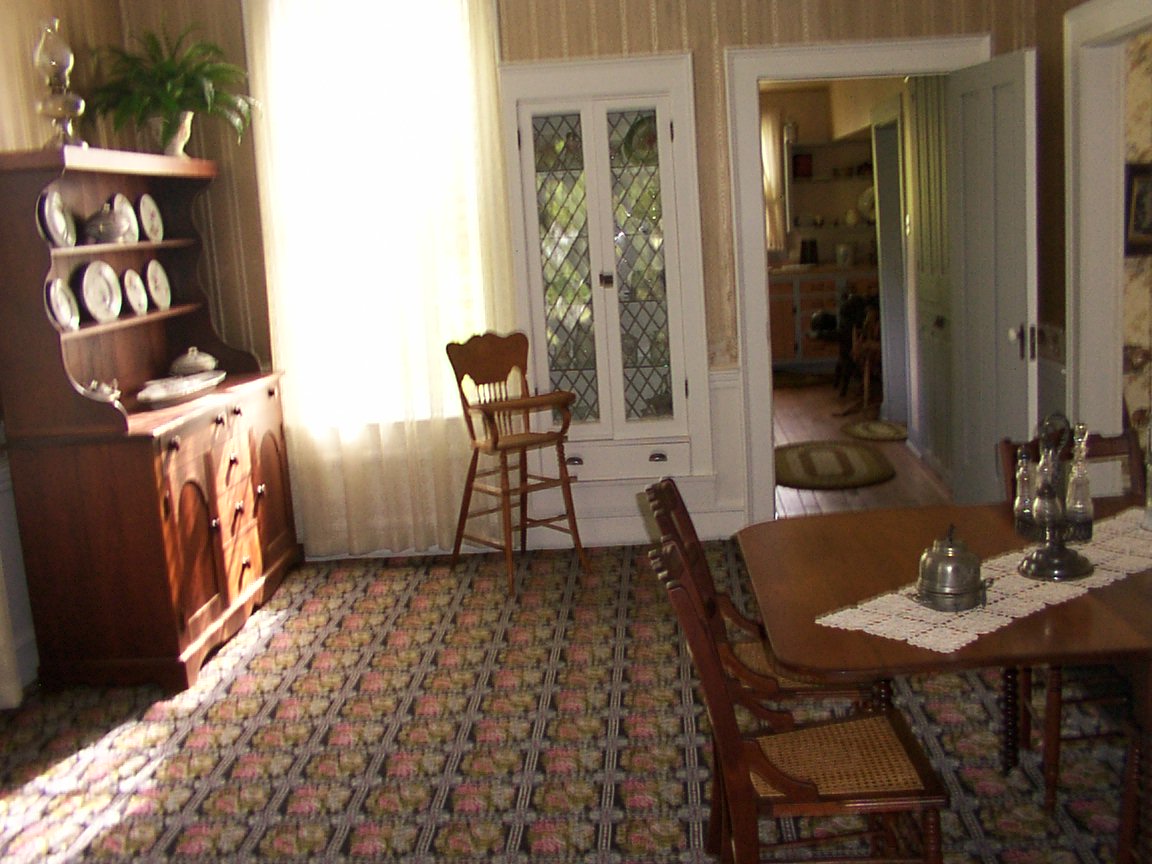 In this room is a particularly interesting piece -- a china
cabinet which is a fairly new piece made in the 1850's style
from walnut wood grown on a Vermilion County farm, and
originally used in a barn. The dining table and
chairs were donated by the same person who gave the china
cabinet. On it you'll see a fish platter and
eight small plates to match, which were used in a
seven (or so) course Victorian Dinner. The cruet
set (oil, vinegar, salt, pepper, and
mustard) on the dining room table was common in a Victorian
home along with the butter dish with catch hole for clarified
butter.
In this room is a particularly interesting piece -- a china
cabinet which is a fairly new piece made in the 1850's style
from walnut wood grown on a Vermilion County farm, and
originally used in a barn. The dining table and
chairs were donated by the same person who gave the china
cabinet. On it you'll see a fish platter and
eight small plates to match, which were used in a
seven (or so) course Victorian Dinner. The cruet
set (oil, vinegar, salt, pepper, and
mustard) on the dining room table was common in a Victorian
home along with the butter dish with catch hole for clarified
butter.
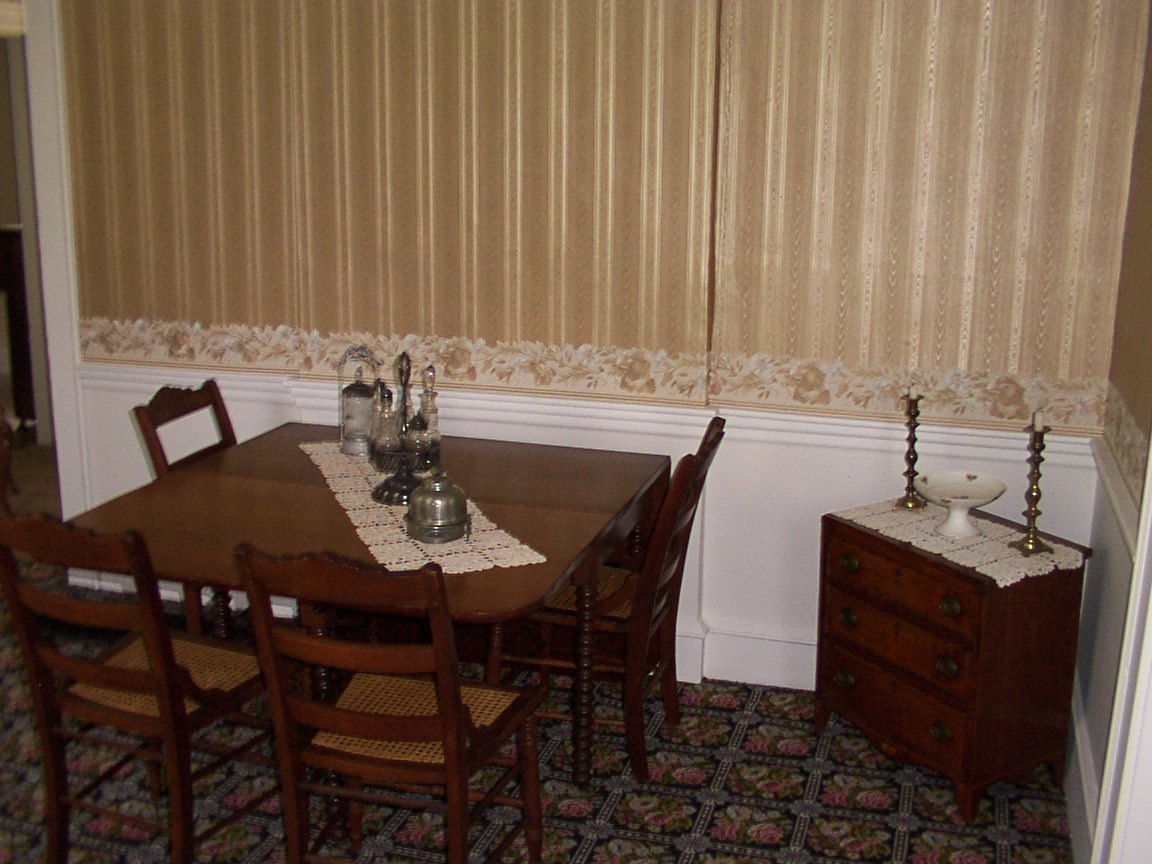 There are lovely pieces of china,
glass and silver also displayed here. A number of
them are in the china cupboard which is in the east wall.
You'll notice the lighting devices, the
kerosene and electrified lamps and candlesticks that appear
in both of these rooms.
There are lovely pieces of china,
glass and silver also displayed here. A number of
them are in the china cupboard which is in the east wall.
You'll notice the lighting devices, the
kerosene and electrified lamps and candlesticks that appear
in both of these rooms.
K I T C H E N The small table by the window is set with tea leaf pattern ironstone by Meakin. And on the wall is a reproduction of the tavern license of Abraham Lincoln when he was a partner, with Berry, in a grocery store-tavern in New Salem, Illinois. This stove from the 1850's was made in Chicago, and bears the name "Kenmore" long before Sears used that designation. It was very advanced for its day -- it could be loaded from either side, and the oven was equally accessible. It also had grates to control the heat of the oven, and an ash-bin for collecting the ashes. On it are a sad iron, a fluting iron and a later iron which had a detachable handle which didn't get as hot as the iron. Each ironer in the family usually had three irons -- one to be used while the other two were heating. Other practical utensils are on the stove -- which, by the way, was purposefully made small so that it could be carried west in a covered wagon in these years, if necessary. The smallest child in the family often had the chore of churning butter in the churn, while he or she sat on the small stool. The bread was put to rise in the large pan which sits near the near the heat of the stove. 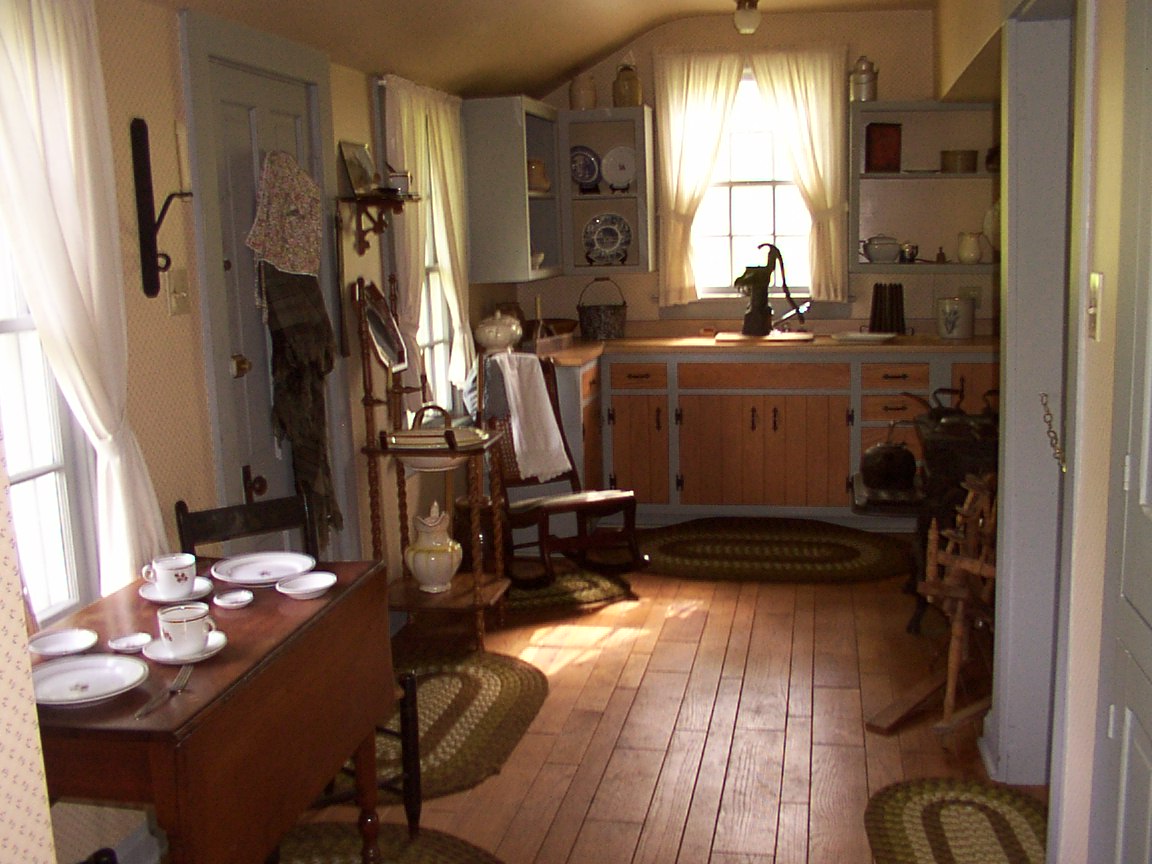
Originally, canning was in the jar you see here. It had a small cap of metal or stoneware which was sealed to it with this sealing wax, then covered with a square of muslin tied on with a piece of string. It was then labeled so the housewife would know what the jar contained. Later, there was a big improvement with a Weir jar -- a rubber seal and clamp-on top. She also frequently made candles in October when her friends in the country would butcher so that she had a supply of tallow. Whether she used this candle mold or used the dipping method, the main thing was to be sure that the wick remained straight in the process so that the candle burned evenly. The washstand was used by the man of the house when he shaved. You'll see his shaving mug, brush and mirror at the top and the pitcher and bowl below. The shawl and the small lantern were used when going to the outhouse in the back yard in cool weather, and the bonnet always was part of the housewife's attire when she did any gardening. She also used sleevelets gathered onto elastic if the dress she wore didn't happen to be long-sleeved, for heaven forbid that she should get a tan or freckles. B E D R O O M 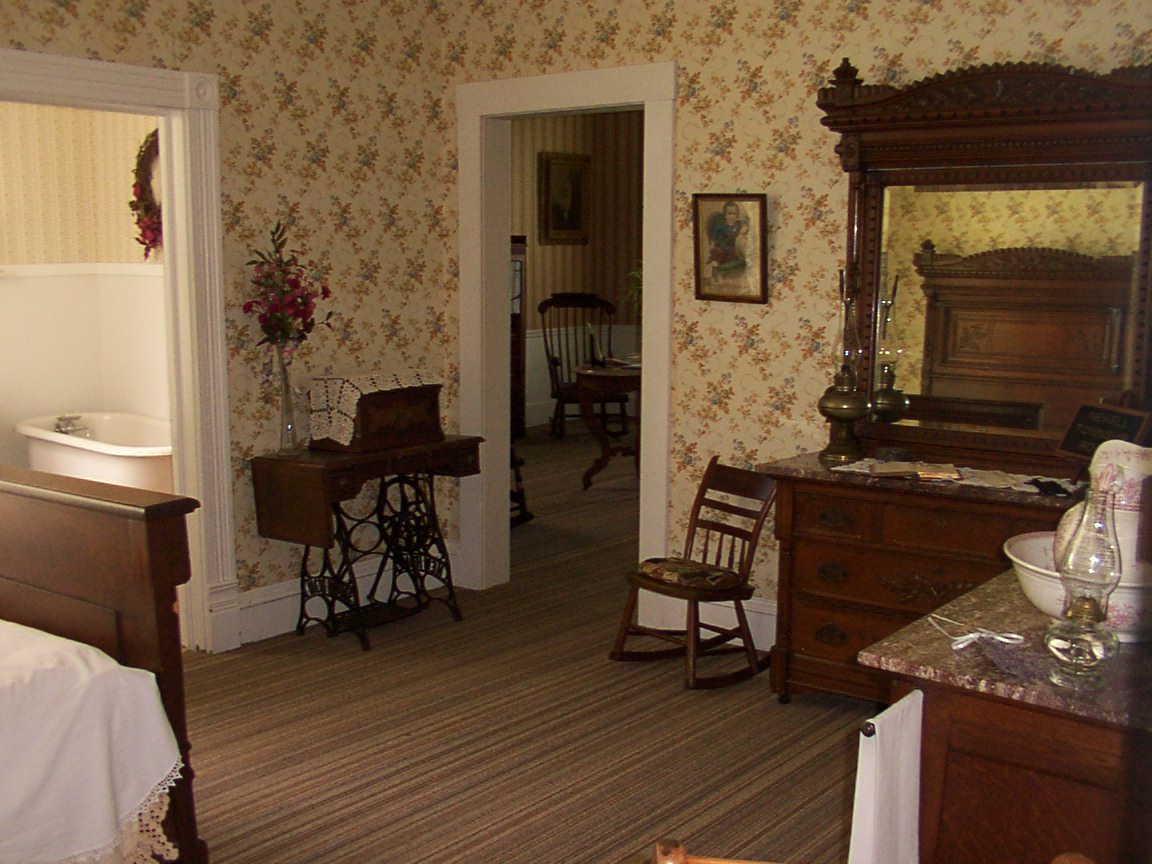 The bed, chest of drawers, and washstand in the
bedroom are from the William Fithian farm home located
west of Fithian. Under the bed is a trundle
bed which pulls out to be used by extra children or quests.
A mattress of straw, corn shucks or
feathers was rolled out onto the ropes. On the
bed is a Jacquard coverlet woven by the LaTourette family of
Fountain County, Indiana. They were one of
the outstanding weaving families of Indiana, and several
of their coverlets are found in this area. Under
it is a ecru bedspread -- lovely -- and under that is a
summer spread with candle wicked ornamentation which matches
the envelope-type pillow shams. You'll also notice
the copper foot warmer which was filled with hot water and
then wrapped in a pillow case, towel or blanket.
The bed, chest of drawers, and washstand in the
bedroom are from the William Fithian farm home located
west of Fithian. Under the bed is a trundle
bed which pulls out to be used by extra children or quests.
A mattress of straw, corn shucks or
feathers was rolled out onto the ropes. On the
bed is a Jacquard coverlet woven by the LaTourette family of
Fountain County, Indiana. They were one of
the outstanding weaving families of Indiana, and several
of their coverlets are found in this area. Under
it is a ecru bedspread -- lovely -- and under that is a
summer spread with candle wicked ornamentation which matches
the envelope-type pillow shams. You'll also notice
the copper foot warmer which was filled with hot water and
then wrapped in a pillow case, towel or blanket.
In the corner you'll see several toys, and a sled that was hitched on behind a horse for winter work on the farm, and probably also used by the children of the family. On the chest of drawers are several items used by the lady of the family as she dressed to go out for a special evening. There is her jewelry box, hair retainer, gloves, velvet hat, and autograph fan, which she would take to a dance. The gentleman's top hat is also there. On the washstand is a pitcher and bowl, razor, and the hair curler that could be heated in the small kerosene lamp to make curls in milady's hair. 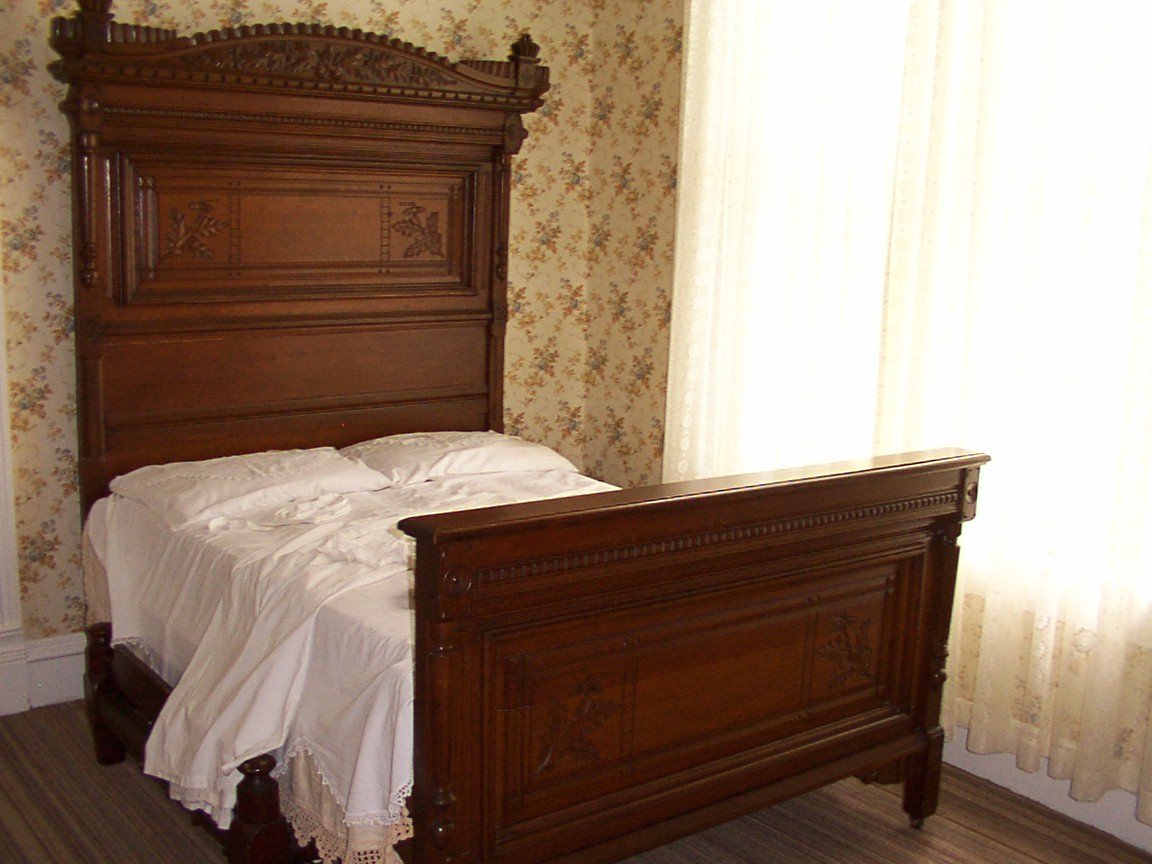
An existing room was turned into an inside bathroom sometime before 1900, we assume, and it was a welcome addition. It might have been used before as a child's room, nursery, dressing room or storage area. And on the wall is a hair wreath made by someone who was very adept at intricate handwork. L I B R A R Y  (Also referred to as the gentlemen's parlor.) There are several particularly interesting pieces of
furniture in this room. This is the secretary that
originally belonged to the Asa Palmer Family of Danville.
Asa was a pioneer doctor of the community,
and started the first drugstore at the corner of Main and
Walnut in 1825. The bookcase was sent from England
in the 1850's and many years later was donated to the museum
by Mrs Bessie McCrone who remembers that when she was a child
her weekly task was to remove all the books, dust them and the
bookcase, and return the books to their proper place.
The coat rack was given by the Red Cross when the
old Tincher home at Seminary and Franklin was demolished to
make way for the new building, and the top had hanging on it
belonged to Joe Tincher.
(Also referred to as the gentlemen's parlor.) There are several particularly interesting pieces of
furniture in this room. This is the secretary that
originally belonged to the Asa Palmer Family of Danville.
Asa was a pioneer doctor of the community,
and started the first drugstore at the corner of Main and
Walnut in 1825. The bookcase was sent from England
in the 1850's and many years later was donated to the museum
by Mrs Bessie McCrone who remembers that when she was a child
her weekly task was to remove all the books, dust them and the
bookcase, and return the books to their proper place.
The coat rack was given by the Red Cross when the
old Tincher home at Seminary and Franklin was demolished to
make way for the new building, and the top had hanging on it
belonged to Joe Tincher.
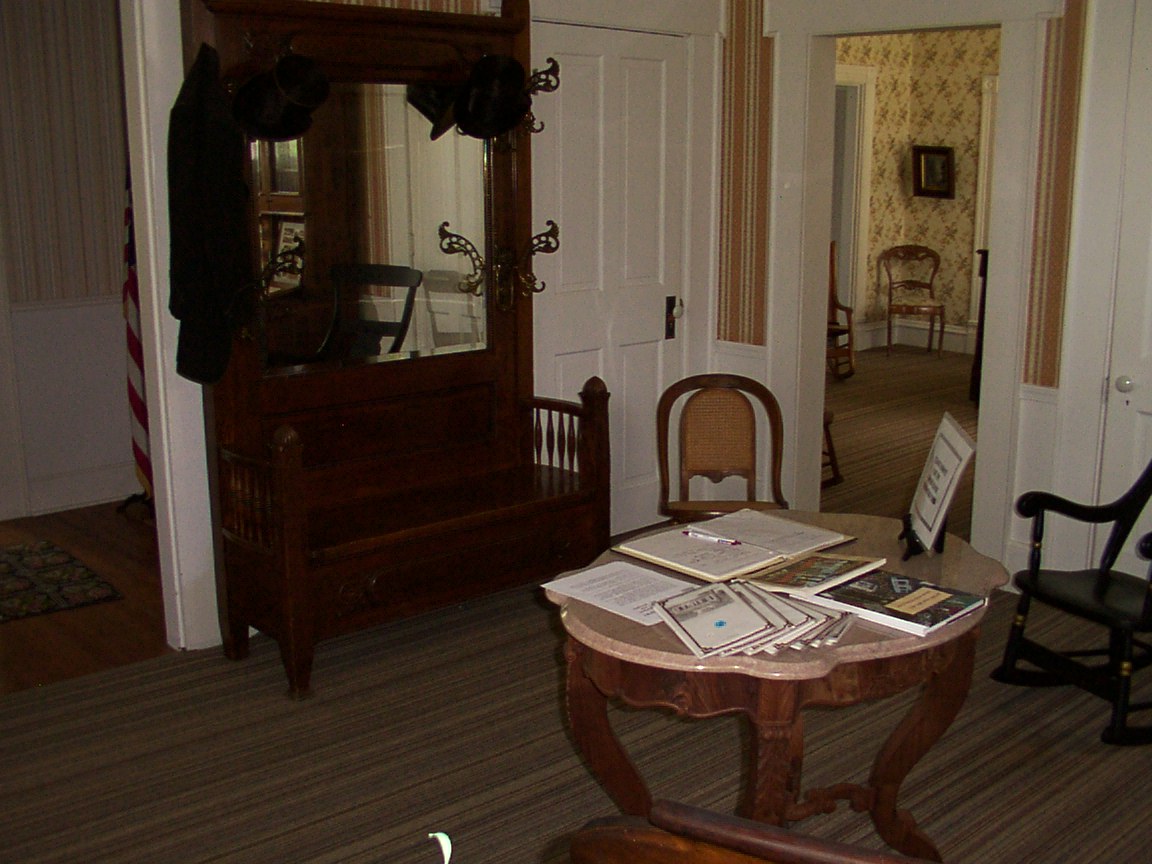 On the wall is a portrait of Jacob Clem of Blount Township.
On the
Secretary is a newspaper clipping about the partnership of
Ward Hill Lamon and Abraham Lincoln.
On the wall is a portrait of Jacob Clem of Blount Township.
On the
Secretary is a newspaper clipping about the partnership of
Ward Hill Lamon and Abraham Lincoln.
We hope you have enjoyed this tour of the house. |
The Lamon House
Vermilion County Museum Society
116 North Gilbert Street
Danville, Illinois 61832
217-442-2922
Lamon House Home Page | Contact The Lamon House
Copyright © 2016, Vermilion County Museum Society All rights reserved.